


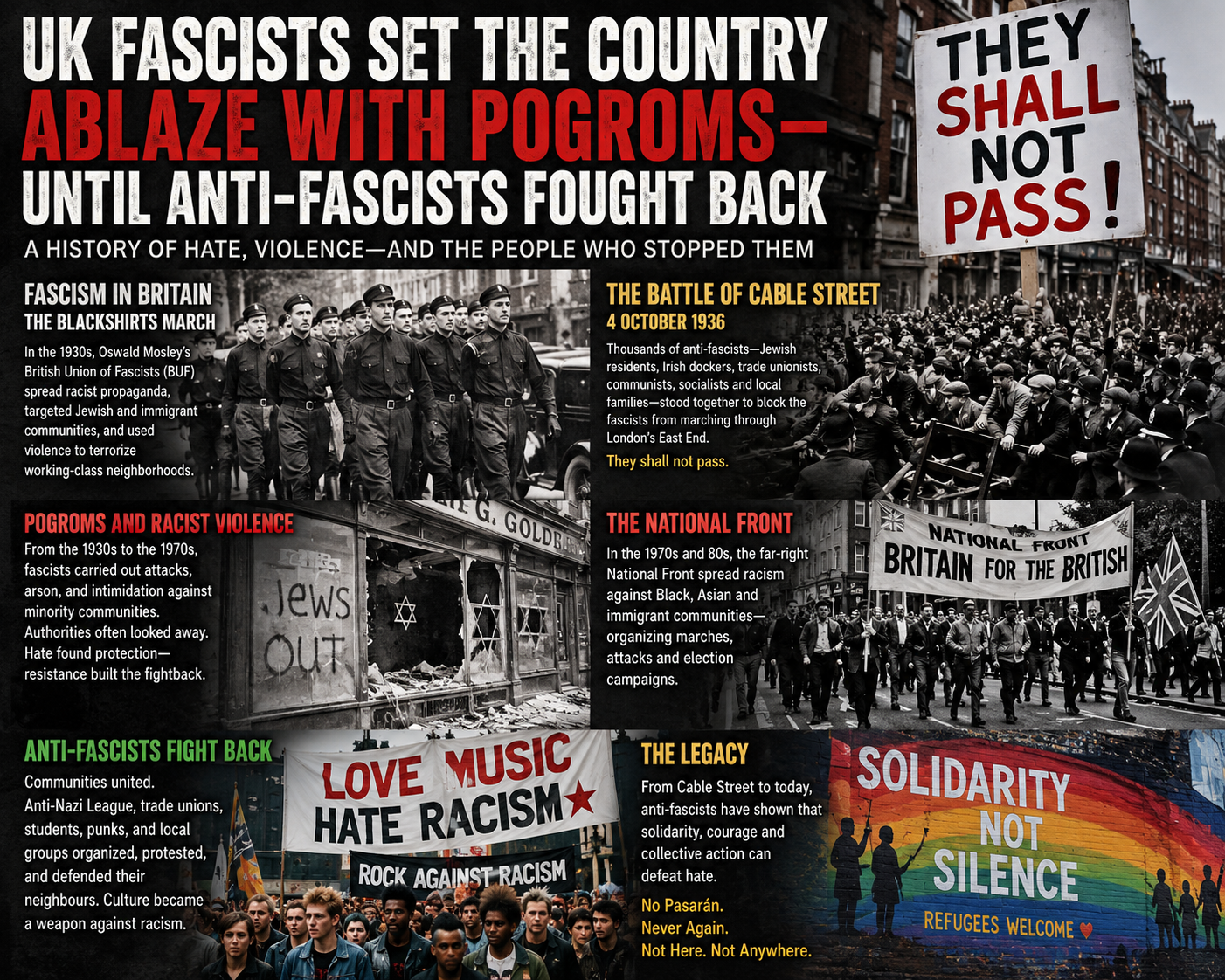
Britain often imagines itself as a country naturally immune to fascism. Popular memory celebrates the defeat of Winston Churchill’s wartime enemies and the nation’s role in resisting Adolf Hitler. Yet beneath this comforting story lies another history: one in which fascist organizations grew openly, spread racist propaganda, and encouraged waves of violence against minorities. At several moments during the twentieth century, Britain’s streets became battlegrounds. What stopped the advance of fascism was not national mythmaking or elite moderation alone, but organized resistance from ordinary people.
The most infamous British fascist movement emerged in the 1930s with the British Union of Fascists (BUF), founded by Oswald Mosley. Inspired by Benito Mussolini and later sympathetic to Nazi Germany, Mosley cultivated a mass movement built on authoritarian nationalism, antisemitism, and violent street politics. His followers, known as Blackshirts, marched through working-class neighborhoods in military-style uniforms, intimidating Jewish communities and political opponents alike.
The East End of London became a particular target. Large Jewish and immigrant populations lived there, alongside Irish workers and dock laborers. BUF organizers deliberately staged provocative marches through these districts, hoping to inflame tensions and demonstrate control of the streets. Violence frequently followed. Shops were vandalized, meetings attacked, and residents terrorized. While Britain never experienced state-organized extermination campaigns like those carried out in Eastern Europe, many contemporaries described these attacks as pogrom-like in character: coordinated outbreaks of mob violence directed at minorities for political ends.
Authorities often appeared reluctant to confront the fascists decisively. Police protection was regularly granted to BUF marches in the name of public order and free speech, even when local communities pleaded for them to be banned. This official neutrality effectively shielded fascist intimidation. Many working-class Londoners concluded that if fascism was to be stopped, they would have to stop it themselves.
That resistance culminated in the Battle of Cable Street on October 4, 1936. Mosley planned a massive march through the East End, backed by thousands of Blackshirts. In response, Jewish residents, Irish dockworkers, communists, trade unionists, socialists, and local families united to block the route. Barricades were erected from furniture, carts, and paving stones. Clashes erupted with police attempting to clear a path for the fascists.
The anti-fascists vastly outnumbered Mosley’s supporters. Their slogan—“They shall not pass”—echoed anti-fascist struggles elsewhere in Europe. After hours of confrontation, authorities finally ordered the BUF to abandon the march. Cable Street became a defining symbol of collective resistance. It demonstrated that fascism could be beaten not merely through speeches in parliament, but through mass mobilization in neighborhoods and workplaces.
The defeat at Cable Street weakened Mosley, but fascism did not disappear from Britain. After World War II, new far-right organizations emerged, exploiting anxieties over immigration and economic decline. During the 1970s, the National Front gained support by targeting Black and Asian communities with racist propaganda and street violence. Immigrant neighborhoods again faced intimidation, arson, and attacks.
Once more, anti-fascist resistance grew from below. Groups such as the Anti-Nazi League organized demonstrations, community defense campaigns, and political education. Cultural movements also played a major role. Rock Against Racism brought musicians and activists together in enormous concerts that challenged racist politics through popular culture. Punk, reggae, and ska performers shared stages before huge multiracial crowds, presenting solidarity as both political and cultural rebellion.
These movements helped isolate the far right socially and politically. Fascist organizations depended on public visibility, fear, and the appearance of unstoppable momentum. Anti-fascists disrupted meetings, exposed organizers, defended targeted communities, and denied them uncontested control of public space. While critics sometimes condemned militant tactics, supporters argued that fascism thrived when treated as just another opinion rather than a violent movement seeking to destroy democratic freedoms.
The British experience reveals an uncomfortable truth: fascism was never simply defeated abroad in 1945. It repeatedly resurfaced at home during moments of crisis and uncertainty. Nor did it vanish automatically through institutional safeguards. Resistance came because ordinary people—workers, immigrants, Jews, trade unionists, students, and activists—organized collectively against racist violence and authoritarian politics.
Today, debates over nationalism, migration, and political extremism continue across Europe. The memory of Cable Street and later anti-fascist struggles remains powerful because it reminds people that democracy is not self-sustaining. When organized hatred attempts to dominate public life through fear and division, it is often collective action from below that determines whether fascism advances or retreats.