

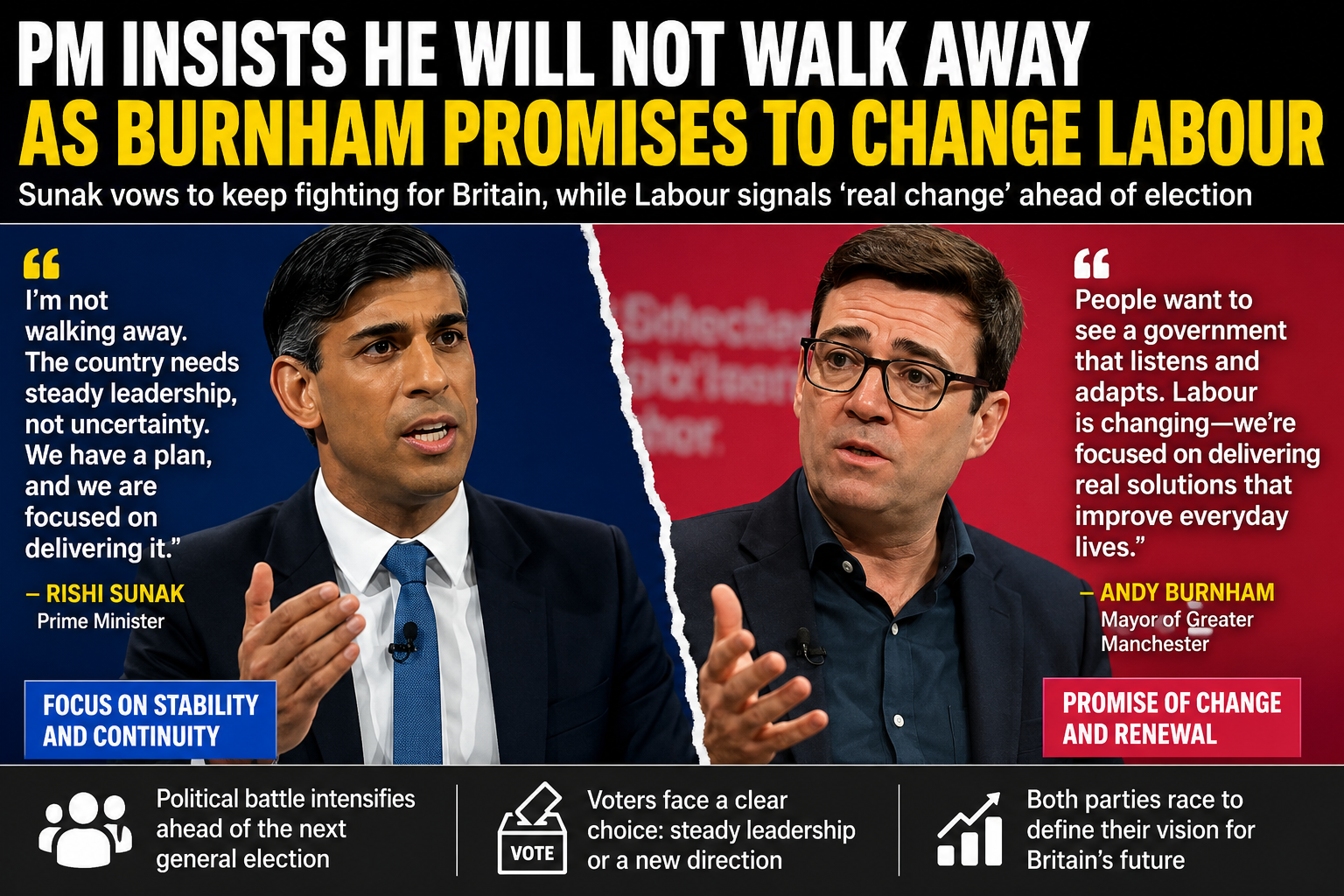
UK Prime Minister Rishi Sunak has insisted he will not “walk away” from the challenges facing the country, even as Andy Burnham signalled that a reformed Labour Party could offer a compelling alternative to voters seeking change.
The comments come at a time of heightened political tension, with both major parties attempting to define their vision ahead of the next general election. Sunak, under pressure from economic stagnation and public dissatisfaction with key services, has sought to project resilience and continuity. Speaking to reporters, he stressed his commitment to leading the country through what he described as a “period of necessary but difficult transition,” arguing that abandoning his post would only deepen instability.
“I’m not walking away,” Sunak said firmly. “The country needs steady leadership, not uncertainty. We have a plan, and we are focused on delivering it.” His remarks were clearly aimed at countering criticism from both opposition figures and factions within his own party, some of whom have questioned whether the government has the political capital to recover from declining approval ratings.
Meanwhile, Andy Burnham has used the moment to underline Labour’s evolving identity under its current leadership. A prominent voice within the party, Burnham suggested that Labour is undergoing meaningful change, positioning itself as both pragmatic and responsive to voters’ concerns. While he stopped short of directly attacking Sunak’s leadership, his comments implied that the electorate may be ready for a different approach.
“People want to see a government that listens and adapts,” Burnham said during a regional event. “Labour is changing—we’re focused on delivering real solutions that improve everyday lives.” His emphasis on transformation reflects a broader strategy within the party to rebuild trust after previous electoral setbacks and present a unified, credible front.
The contrast between Sunak’s insistence on continuity and Burnham’s emphasis on change highlights a central dividing line in current UK politics. For the Conservatives, the argument rests on stability and experience, even amid criticism. For Labour, the message is one of renewal—an attempt to convince voters that the party has learned from past mistakes and is ready to govern effectively.
Political analysts suggest that both approaches carry risks. Sunak’s refusal to “walk away” may reassure some voters who value consistency, but it also ties him closely to the government’s record at a time when many are dissatisfied. On the other hand, Labour’s promise of change must overcome lingering doubts about its economic credibility and internal unity.
Burnham’s role in shaping Labour’s message is particularly noteworthy. As Mayor of Greater Manchester, he has cultivated a reputation for outspoken advocacy on regional issues, often challenging central government policies. His influence within the party extends beyond his formal position, making his endorsement of Labour’s current direction a significant signal.
At the same time, Sunak faces the challenge of maintaining cohesion within the Conservative Party while addressing public concerns over inflation, healthcare, and economic growth. His leadership style—often described as technocratic and cautious—may appeal to some voters, but critics argue it lacks the boldness needed to inspire confidence in difficult times.
As the political landscape continues to shift, the exchange between Sunak and Burnham underscores the broader narrative shaping the next election: a contest between persistence and transformation. Whether voters ultimately favour the promise of steady leadership or the appeal of a reimagined alternative remains to be seen.
For now, both sides appear determined to define the debate on their own terms. Sunak’s message is clear—he intends to stay the course. Burnham, and the Labour Party more broadly, are equally clear in their ambition to chart a different path. The coming months will reveal which vision resonates more strongly with an electorate increasingly eager for results.