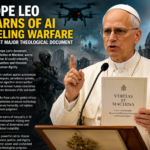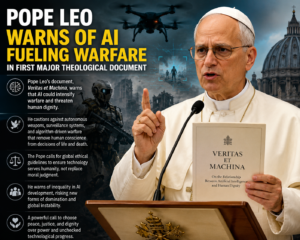


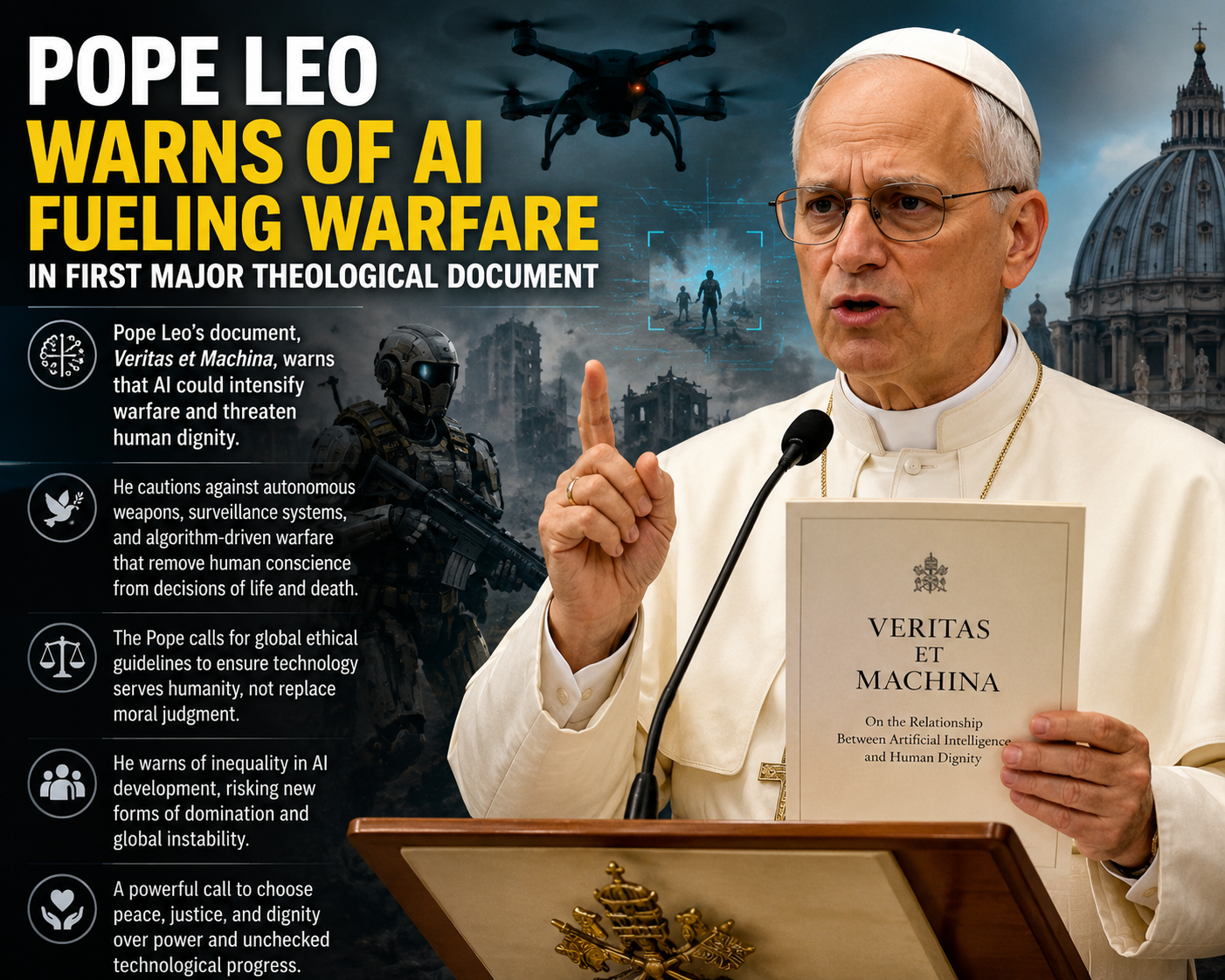
In a landmark moment for both religious thought and global ethics, Pope Leo XIV has issued his first major theological document, warning that the rapid advancement of artificial intelligence (AI) could intensify warfare and threaten the moral fabric of humanity. The document, released from the Vatican, signals a growing concern within the Catholic Church about the ethical implications of emerging technologies in modern conflict.
Titled Veritas et Machina (“Truth and the Machine”), the document outlines the Pope’s vision of a world at a crossroads, where technological innovation must be guided by moral responsibility. Pope Leo emphasizes that while AI has the potential to improve human life, its application in military contexts presents profound dangers. Autonomous weapons, surveillance systems, and algorithm-driven warfare, he argues, risk distancing human decision-makers from the consequences of violence.
“War must never become a calculation devoid of conscience,” Pope Leo writes in the text. “When machines are permitted to decide matters of life and death, humanity risks losing its own soul.” The statement reflects a deep concern that AI could depersonalize warfare, making it easier for nations to engage in conflict without fully grappling with its human cost.
The Pope’s warning comes at a time when global powers are investing heavily in AI-driven defense systems. From drone swarms to predictive targeting algorithms, modern militaries are increasingly integrating machine learning into their operations. Critics of this trend argue that such technologies could lower the threshold for war, enabling faster and potentially less accountable decisions.
Drawing on centuries of Catholic social teaching, Pope Leo frames the issue within the broader context of human dignity and the sanctity of life. He calls for international cooperation to establish clear ethical guidelines governing the use of AI, particularly in armed conflict. “Technology must serve humanity, not replace its moral judgment,” he asserts, urging world leaders to prioritize peace over power.
The document also highlights the risk of inequality in AI development. Wealthier nations, with greater access to advanced technologies, could gain disproportionate military advantages, further destabilizing global relations. Pope Leo warns that this imbalance could lead to new forms of domination and exploitation, echoing historical patterns of injustice.
In addition to geopolitical concerns, the Pope addresses the psychological and spiritual impact of AI-driven warfare. He suggests that reliance on machines in combat could erode empathy among both soldiers and civilians. “When the face of the enemy is reduced to data, compassion becomes a casualty,” the document states.
The Vatican’s intervention places it among a growing number of voices calling for stricter regulation of AI in military use. International organizations and advocacy groups have similarly urged governments to ban or limit autonomous weapons systems, often referred to as “killer robots.” Pope Leo’s contribution adds a moral and theological dimension to these debates, potentially influencing millions of Catholics worldwide.
Reactions to the document have been mixed. Some policymakers have welcomed the Pope’s stance, viewing it as a timely reminder of the ethical responsibilities that accompany technological progress. Others, particularly in defense sectors, argue that AI can make warfare more precise and reduce unintended casualties when used responsibly.
Despite differing perspectives, the release of Veritas et Machina underscores the urgency of addressing the ethical challenges posed by AI. Pope Leo concludes his document with a call to action, urging humanity to choose a path that upholds dignity, justice, and peace. “The future is not written by machines,” he writes, “but by the choices we make in guiding them.”
As the world grapples with the rapid evolution of artificial intelligence, the Pope’s message serves as a powerful reminder that technological advancement must not outpace ethical reflection. Whether his warning will translate into concrete policy changes remains to be seen, but it has undoubtedly sparked a crucial conversation at the intersection of faith, technology, and global security.